
 Quincymccoy
Danger! 101:
[Math warning]
So why would so many competitive players use Danger! monsters if you are theoretically losing card advantage to activate their first effect? Well, the above math changes if your opponent happens to hit a card that itself can provide card advantage when discarded. So, now if a card provides a +1 when discarded, you can think of the entire exchange as a potential net positive in card advantage. Going back to our card advantage numbers, for a standard opening hand you get “+0.8” in advantage to the “+0.5” case of two cards. It is only an even trade in total card advantage if you discard the revealed Danger itself (and it has a card advantage effect when discarded). I will be revisiting these math calculations throughout the article, so feel free to continue reading the sections or skipping them, as your heart desires.
[Math Over]
Advantage Dangers
As a tier, these Dangers provide the backbone for your deck. If consistency was your only consideration, these could always be the Danger you reveal from your hand. This is the case, because it is always safe to activate them. Since these all provide even advantage at worst, you will never lose card advantage from revealing one from this tier.
Conditional Dangers
As a tier, these dangers can provide a bit more power to the deck. Consistency alone doesn’t win games, so these cards let you turn power plays to get the duel into your favor. In situations where their effect(s) would be able to activate, these could be the Danger you reveal from your hand, as you still guarantee even card advantage in specific circumstances. For example, if your opponent controls no cards, you should not be activating Bigfoot before you activate a Tsuchinoko. Or if you don’t have a specific card in hand that provides advantage when discarded, you should not activate Mothman before Nessie.
Potential Danger
The last Danger monster, Danger! Dogman, remains off my tierlist entirely because he does not offer any advantage or delayed advantage, thus he is not worthy of consideration for valuable deckspace. It’s off to the doghouse with him.
[Math 2 warning]
Spoiler
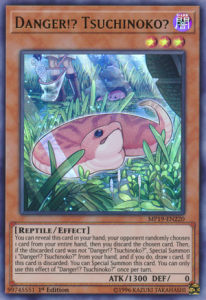 If you chose Tsuchinoko: 20% chance to just summon the discarded Tsuchinoko. 20% chance of discarding Nessie (-1), summoning Tsuchinoko, drawing a card (+1), then searching a Danger card (+1). 20% chance of discarding Ogopogo (-1), summoning Tsuchinoko, drawing a card (+1), then sending a Danger card to GY. 40% chance of discarding a Danger that can’t activate (-1) and just drawing a new card to replace it (+1).
Card advantage total for revealing Tsuchinoko- 0+.2+0+0+[…]+.2 = “0.4” factoring in the delayed advantage from Ogo.
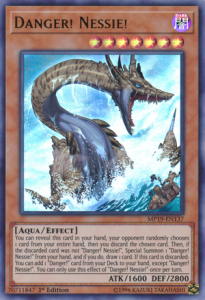 If you chose Nessie: 20% chance to just search a new Danger to replace the discarded Nessie. 20% chance of discarding Tsuchinoko (-1), summoning Nessie, drawing a card (+1), then summoning back Tsuchinoko (+1). 20% chance of discarding Ogopogo (-1), summoning Nessie, drawing a card (+1), then sending a Danger card to GY. 40% chance of discarding a Danger that can’t activate (-1) and just drawing a new card to replace it (+1).
Card advantage total for revealing Nessie – 0+.2+0+0+[…]+.2 = “0.4” factoring in the delayed advantage from Ogo.
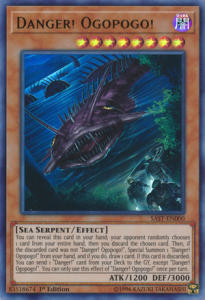 If you chose Ogopogo: 20% chance to just send a Danger card to GY. 20% chance of discarding Tsuchinoko (-1), summoning Ogopogo, drawing a card (+1), then summoning back Tsuchinoko (+1). 20% chance of discarding Nessie (-1), summoning Ogopogo, drawing a card (+1), then searching a Danger card. 40% chance of discarding a Danger that can’t activate (-1) and just drawing a new card to replace it (+1).
Card advantage total for revealing Ogopogo – (-.2)+.2+.2+0+[…]+.2 = “0.4” factoring in the delayed advantage from Ogo.
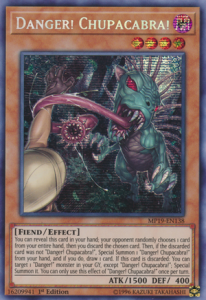 If you chose Bigfoot or Chupacabra: 20% chance to just discard the revealed Danger. 20% chance of discarding Tsuchinoko (-1), summoning Bigfoot or Chupacabra, drawing a card (+1), then summoning back Tsuchinoko (+1). 20% chance of discarding Nessie (-1), summoning Bigfoot or Chupacabra, drawing a card (+1), then searching a Danger card. 20% chance of discarding Ogopogo (-1), summoning Bigfoot or Chupacabra, then sending a Danger card to GY. 20% chance of discarding the other Danger that can’t activate (-1) and just drawing a new card to replace it (+1).
Card advantage total for revealing Bigfoot or Chupacabra – (-.2)+.2+.2+0+[…]+.2 = “0.4” factoring in the delayed advantage from Ogo.
 At first glance, this may have seemed like a trick question as any of the above options results in the same exact overall card advantage. But take a closer look at the incremental advantage of each potential scenario which adds up to the total. Where you see negatives in the string of operations indicates that some possibilities would lose you card advantage. So, to minimize the risk, it is mathematically recommended to begin with Tsuchinoko or Nessie! However, low-risk play encourages low rewards, so it is up to you as a duelist to decide if you want a greater chance of a ‘+1’ off of a Danger effect or no chance of a ‘-1’.
To get back to answering the original question, which Danger you picked for this scenario might help you to understand what kind of risk-tolerance you have as a duelist.
It’s also important to note that the scenarios and above discussion may change as the duel progresses. Playing against an archetype with a strong grind game, you may want to risk more to get the duel over with before you get out-resourced. All I’m saying is that you might have different priorities at that point; you may have better potential options. So ensure that the order you reveal your Danger! monsters is deliberate.
[Math 2 over]
Dangerous Support
Turning to Outside Support
But while Beginning provides some long term benefits, we still need to figure out what else to pair with the Dangers to benefit from their discarding. There’s a couple of options, so let’s discuss them:
Enough chat about various engines and archetypes, let’s look at a proposed decklist already and see how it can all come together.
The Decklist:
Click to view the Interactive Decklist in the Official Card Database.
Spoiler
Monsters: 29
|| Danger! Nessie!
|| Danger!? Jackalope?
|| Danger!? Tsuchinoko?
||| Danger! Bigfoot!
||| Danger! Thunderbird!
||| Danger! Chupacabra!
||| Danger! Mothman!
||| Danger! Ogopogo!
|| Broww, Huntsman of Dark World
| Snoww, Unlight of Dark World
| Duke Shade, the Sinister Shadow Lord
| Rafale, Champion Fur Hire
|| Iron Dragon Tiamaton
| Phantom Skyblaster
Spells: 8
| Danger! Response Team
||| The Beginning of the End
|| Recurring Nightmare
|| Super Polymerization
Traps: 4
||| Danger! Zone
| Second Expedition into Danger!
Extra Deck: 15
| Mudragon of the Swamp
| Predaplant Triphyoverutum
| Starving Venom Fusion Dragon
| Salamangreat Violet Chimera
| Black Luster Soldier – Soldier of Chaos
| Borrelsword Dragon
| Curious, the Lightsworn Dominion
| I:P Masquerena
| Knightmare Cerberus
| Knightmare Phoenix
| Knightmare Gryphon
| Knightmare Unicorn
| Mekk-Knight Crusadia Avramax
| Wee Witch’s Apprentice
| Folgo, Justice Fur Hire
My Choices:
Take the fact that I went with a combination of DARK support, Super Poly, Fur Hire, and Dark World as my engines with a grain of salt as there are plenty of options available. At the end of the day, you need to pick those that match your playstyle. My playstyle revolves around generating high moments as much as possible, moments where the deck can shine standing on its own. But you might be a player who values consistent performance more. Or you might be a player that wants to be able to combo out of any potential 5-card hand you are dealt. So pick what matches you. That’s my advice on this one.
You might even say that your opponent is in Danger of being beaten out of nowhere with these options.
Alternate Tech Options:
[Math 3 warning]
Card Design with a Splash of Game Theory
Let’s take the math piece of this article a step beyond simple card economy and get more strategic. For the majority of archetypes in the game, there are primarily two styles of design – let’s denote them as linear and non-linear decks. Linear decks are ones that are centered around a core set of plays, the rest of the deck is designed to make that core play happen as often as possible or to maximize the advantage in game state from doing so. A good example of this is Orcust – at the end of the day, you want to get Harp into the GY so you can begin the chain of Orcust effects. Sure, your end board can vary depending on if you want to go into Topologic, or sit on your Galatea to ensure that you have a live Crescendo, but outside of that, much of the path is the same. Compare that to a deck like Sky Striker, where your plan constantly changes because you can arrange your resources at will each turn. Sure, you want to always end on a Striker link with a Raye in GY, but the rest of your setup will change. This is an example of a non-linear deck. Now add Dangers to the mix and you actually can enable archetypes to switch between these two categories.
So let me roll this concept back into my initial claim that Dangers let you delineate a strategy. By playing a Danger engine in any deck, you are choosing to insert player controlled randomness into the duel. Sure, you can’t control what is discarded when you activate one of their effects. But you do get to control the probabilities of coming out ahead. Think to the example of a Salamangreat deck playing a small Danger engine. What your opponent chooses for you to discard will give you options to continue forward in the duel with your opening plays. Does this mean that every deck should play Dangers? No, that’s not my claim at all. What I hope you get out of this is that Dangers are designed to push other themes further – think of them as an extender for archetype potential if you are familiar with the concept of extenders in your deck. That’s what makes the theme have such neat card design – its impact on the rest of the game.
While this entire segment may not seem all that math heavy – this may just be the most in-depth math section in here. I personally define mathematics as a field where you try to find patterns to determine the truth of things. But beyond my definition, it is commonly accepted that logic is just a subdiscipline of mathematics. And since I’ve been working through a logical argument for the classification of Dangers to the observed categories of archetypes, we’ve just been doing math. Hopefully if you are someone who has taken the time to read these sections, you’ll start to realize that math can be a lot more than just numbers, formulas, and homework – it actually can give pretty neat insight into a lot of different fields. Even Yu-Gi-Oh card design.
[Math 3 over]
Conclusion:
The Danger! archetype has a ton of potential with so many different archetypes. It’s theme is also unique, drawing upon the cryptids of legend to make your opponent search for the hidden monsters. It has so much synergy with other archetypes and themes, everything from Blue-Eyes to Fur Hire. Lastly, it is just freaking cool to actually interact with your opponent. I dont know about you, but Yu-Gi-Oh is just much more fun that way! Anyways, hopefully the math included in the article didn’t fry your brain too much, but I’ll be back soon with another article! Thanks for reading!
Reminder, I also take suggestions for future CDS articles! I really want to see some input from you! If you wish to see a CDS article about the archetype, theme, or strategy you love, feel free to private message me on the YGOrg Discord server, the YGOrganization Forums, or just post a comment in response to this article on our Facebook page with your ideas to keep under consideration! On most YGO-related communities my username is Quincymccoy, so feel free to reach out.